
 Je ziet wel dat de intensiteit van het rode (tan) verschilt per hond. Nu dacht ik dat dit op de C locus lag (http://abnormality.purpleflowers.net/ge ... albino.htm" onclick="window.open(this.href);return false;), maar vandaag ontdekte ik dit:
BronIf we have not been selecting against the red Corgi coat, on the other hand, a second theory concerning paling may explain why we have still had difficulty getting and keeping the red and darker tan coat colors. A Russian, N. A. Iljin, writing in 1932 and 1934 held that a further series affects the intensity of tan coloration in the dog. The series consists of three genes: the dominant "Int" dilutes tan towards a dirty white; the next step down in the series "intm" dilutes tan towards a light yellow or fawn; and the lowest of the series "int" results in no dilution. Here the alleles for the truly red or tan coat would be recessive. Thus if you bred a paler coated animal to an undiluted colored animal, you would still get coat colors that were diluted, but would carry the allele for undiluted pigment. It would only be by breeding that generation to an undiluted colored animal that you would see some undiluted or truly red or tan coats. It has been suggested that incomplete dominance plays a large part in Iljin's "Int" series so that the six possible genotypes can give six shades of dilution ranging from "Int Int" with the most dilution to "int int" with no dilutions. Such a theory would better explain the many varying shades of red, yellow and tan in the Corgi and would also help explain why the now established pale colors are in the majority and seem so hard to get rid of.
If we were to designate the palest fawns and sands "Int intm"; the light reds, golds and fawns "Int int" or "intm intm"; the bright reds and rich golden reds as "intm int" and the deep reds, dark tans and dark sable reds "int int" we would pretty much cover the varying shades of Corgi coat color and would need to be prepared to see the occasional cream coat of the "Int Int" individual, of which there is now an occasional one occurring.
Hoe zit het nou, is de C-locus nu verantwoordelijk voor de intensiteit of dat Int gedoe?

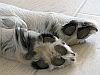
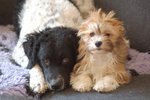
 Ik heb het over phaeomelanin, dus rood (dat is volgens mij hetzelfde rood als de tanpoint, want je hebt alleen eumelanin en phaeomelanin).
 Maar ik bedoel, Keeffer's rood is dieper dan de tanpoint van zijn moeder, en volgens mij hetzelfde type rood als dat van zijn paps. Wat veroorzaakt dan het verschil in intensiteit?

