
Ster topic:
Kijk je naar goedkopere alternatieven voor je hond nu alle de prijzen zo uit de bocht vliegen?
Ster topic! Klik hier om te reageren
Ben je nieuw en wil je een account maken? Klik hier!
Een (zeer) beknopte handleiding voor nieuwe leden vind je hier: Klik!
Het hondenforum team stelt zich hier voor: Klik!
Laatste wijziging 23-03-2022
Wil je deze forummededeling niet meer zien? klik dan rechtsboven in dit vak
Kijk je naar goedkopere alternatieven voor je hond nu alle de prijzen zo uit de bocht vliegen?
Ster topic! Klik hier om te reageren
Ben je nieuw en wil je een account maken? Klik hier!
Een (zeer) beknopte handleiding voor nieuwe leden vind je hier: Klik!
Het hondenforum team stelt zich hier voor: Klik!
Laatste wijziging 23-03-2022
Wil je deze forummededeling niet meer zien? klik dan rechtsboven in dit vak
Poolhonden
Moderator: moderatorteam
-
boxersien
Poolhonden
Wie weet waarom ver weg de meeste (zo niet alle) poolhonden een krulstaart hebben?
-
yamie

- Zeer actief
- Berichten: 24195
- Lid geworden op: 15 jan 2004 05:19
- Mijn ras(sen): Jack Russell Terriers
- Locatie: Goor
- Contacteer:
ik weet het niet zeker, ooit is me verteld , dat het was, zodat de honden hun kop goed warm kunnen houden en beschermen wanneer ze slapen ( in de natuur dus, in de kou ( op slede tochten, expedities enz) doordat er een flinke beharing en krul is, kunnen ze hem heel gemakkelijk om hun hele kop krullen en zo gaan slapen.
idd een husky heeft geen uitgesproken krulstaart, maar ze mogen de staart ook hoog dragen, in een elegante krul ( niet langs het lichaam en niet vlak op het lichaam) waarom? geen idee
idd een husky heeft geen uitgesproken krulstaart, maar ze mogen de staart ook hoog dragen, in een elegante krul ( niet langs het lichaam en niet vlak op het lichaam) waarom? geen idee
-
Scooby
- Zeer actief
- Berichten: 11376
- Lid geworden op: 05 mei 2002 01:32
- Mijn ras(sen): Duitse dog
- Aantal honden: 1
- Locatie: Zutphen
- Contacteer:
Omdat een krulstaart de meest "oer"staartdracht is. Anders dan de meeste mensen denken, omdat een wolf een lagere staartdracht heeft. Kijk maar eens naar honden die jarenlang gecoupeerd zijn en waarbij dus niet op staartdracht is geselecteerd, deze honden hebben vaak een krulstaart (bijv. de Bouvier). Kijk ook maar eens naar zwerfhonden in Zuid-Europa; zodra er geen selectie plaatsvindt, gaat de staart in de krul.
Waarom precies weet ik niet, misschien omdat de hond wellicht niet van de wolf afstamt zoals wij allemaal denken?!?
Waarom precies weet ik niet, misschien omdat de hond wellicht niet van de wolf afstamt zoals wij allemaal denken?!?
Groetjes, Karen
Duitse doggen 'Uut Sutfene'
Duitse doggen 'Uut Sutfene'
-
sirene
- Zeer actief
- Berichten: 14194
- Lid geworden op: 29 aug 2003 20:57
- Contacteer:
Behalve de Basenji ken ik niet veel oerrassen met een krulstaart hoor.Scooby schreef:Omdat een krulstaart de meest "oer"staartdracht is. Anders dan de meeste mensen denken, omdat een wolf een lagere staartdracht heeft. Kijk maar eens naar honden die jarenlang gecoupeerd zijn en waarbij dus niet op staartdracht is geselecteerd, deze honden hebben vaak een krulstaart (bijv. de Bouvier). Kijk ook maar eens naar zwerfhonden in Zuid-Europa; zodra er geen selectie plaatsvindt, gaat de staart in de krul.
Waarom precies weet ik niet, misschien omdat de hond wellicht niet van de wolf afstamt zoals wij allemaal denken?!?
Ik geloof niet zo in deze theorie.
Groetjes Sonja
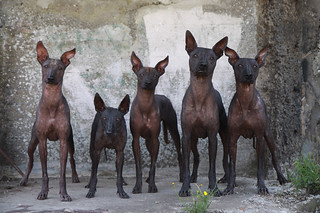
en de nakers
en de nakers
-
Scooby
- Zeer actief
- Berichten: 11376
- Lid geworden op: 05 mei 2002 01:32
- Mijn ras(sen): Duitse dog
- Aantal honden: 1
- Locatie: Zutphen
- Contacteer:
Ik neem aan dat je bedoelt dat de Basenji het enige oerras, maar niet Poolhondenras is wat geen krulstaart heeft? Wat dacht je van de verschillende Keeshonden? Die zou ik ook niet onder het kopje Poolhond willen scharen. En de Lapinporokoira, poolhond, maar weer geen krulstaart. Ik heb de scheiding oerras-poolhondenras niet helemaal helder, trouwens.sirene schreef:Behalve de Basenji ken ik niet veel oerrassen met een krulstaart hoor.
Ik geloof niet zo in deze theorie.
Dan nog een vraag: wat IS een krulstaart? De krulstaart van een Basenji is weer niet te vergelijken met die van een Husky en een Malamute, eerder met die van de Elandhond, bijvoorbeeld.
Reden voor een hoge staartdracht is dat het praktischer is voor de slee, dan zit het ding niet in de weg. Een lage staart kan de achterbuurman hinderen of in de wirwar van treklijnen komen. Bij de Noordelijke jachthonden onderscheidt een hond met een krulstaart zich duidelijk van een wolf, ook wel zo prettig als je bedenkt dat er ieder jaar weer toch dergelijke jachthonden sneuvelen omdat idioten, ondanks de staart, niet kunnen zien dat het een hond is en denken dat het een wolf is en ze doodschieten.
Groetjes, Karen
Duitse doggen 'Uut Sutfene'
Duitse doggen 'Uut Sutfene'
-
sirene
- Zeer actief
- Berichten: 14194
- Lid geworden op: 29 aug 2003 20:57
- Contacteer:
Dat laatste is dus de reden, er is gewoon op geselecteerd.Scooby schreef:Ik neem aan dat je bedoelt dat de Basenji het enige oerras, maar niet Poolhondenras is wat geen krulstaart heeft? Wat dacht je van de verschillende Keeshonden? Die zou ik ook niet onder het kopje Poolhond willen scharen. En de Lapinporokoira, poolhond, maar weer geen krulstaart. Ik heb de scheiding oerras-poolhondenras niet helemaal helder, trouwens.sirene schreef:Behalve de Basenji ken ik niet veel oerrassen met een krulstaart hoor.
Ik geloof niet zo in deze theorie.
Dan nog een vraag: wat IS een krulstaart? De krulstaart van een Basenji is weer niet te vergelijken met die van een Husky en een Malamute, eerder met die van de Elandhond, bijvoorbeeld.
Reden voor een hoge staartdracht is dat het praktischer is voor de slee, dan zit het ding niet in de weg. Een lage staart kan de achterbuurman hinderen of in de wirwar van treklijnen komen. Bij de Noordelijke jachthonden onderscheidt een hond met een krulstaart zich duidelijk van een wolf, ook wel zo prettig als je bedenkt dat er ieder jaar weer toch dergelijke jachthonden sneuvelen omdat idioten, ondanks de staart, niet kunnen zien dat het een hond is en denken dat het een wolf is en ze doodschieten.
Niet dat de krulstaart een oerstaartdracht is.
Groetjes Sonja
en de nakers
en de nakers
-
Podenji
- Zeer actief
- Berichten: 9772
- Lid geworden op: 08 sep 2003 14:11
- Mijn ras(sen): Podenco Ibicenco, Basenji
- Aantal honden: 8
- Contacteer:
het schijnt zo te zijn dat de basenji een krulstaart heeft zodat hij er minder last van heeft tijdens het jagen in de dichtbegroeide bebossing, dit zou dan wel door natuurlijke selectie komen omdat het een ras is waar niet aan gekunseld is van oorsprong, de wilde basenjis in afrika hebben ook nog een gekrulde staart, natuurlijk word er in de"'beschaafde"wereld sterker op gefokt, en de strak gekrulde staarten die we hier zien zullen we in afrika niet snel zien, maar van oorsprong zat de krul er al in, maar waarom zullen we nooit zeker weten.
maar wat hier van te zeggen: erg lang verhaal maar zeer intressant en stof om over na te denken het gaat natuurlijk in dit onderwerp over het stukje over de vossen met gekrulde staarten maar als ik de rest van het artikel weglaat wordt het misschien onduidelijk
Evolution in Action
A fair and balanced fox
by Bryan Zepp Jamieson
2/10/04
Nova aired a program February 3rd called "Dogs and More Dogs". Since I own three of the critters (two Samoyeds and a Cockeyed Spanule) plus a wolf mix, I decided to watch. It was the usual good standards I expect from Nova, and as is usually the case, I finished watching the show with more knowledge that I had going in. There are some who might observe that I am damning Nova with faint praise, but I checked with all of my dogs, and they think I’m a splendid person. Especially when I reach for the leads. Or the dog bowls.
The program dwelled on how the dog developed (whether it was deliberate breeding by humans over the past 14,000 years, or whether the canid carrion eaters attracted to human refuse about the time the first villages were formed became more familiar with humans and thus better fed) and why there is so much diversity among dogs. And why they differ so much from their canid cousins: wolves, foxes, and hyenas.
With a wolf in the house, that last caught my attention. Riley, who is half Virginia red wolf and half German Shepard, came to us four years ago at the age of 8. As a pup, he had an accident which cost him his tail and, according to our vet, resulted in some fairly major work in reconstructing his hip. Not that he ever seemed to notice; he’s quite capable of being friendly without wagging, and can clear a six foot fence effortlessly, quite a feat for a guy who is twelve years old. But it’s his characteristics that are not "dog" features that make him interesting. For instance, his unleashed manner of walking. Dogs will go back and forth erratically, sniffing at things, easily distracted. Riley walks with a very distinct air of purpose; he picks his next destination, and once the decision is made, the journey is a straight line, "A" to "B". His demeanor was so calm and aloof when we got him that my wife nicknamed him "Spock." When we got him, he didn’t bark, although being exposed to two rambunctious Samoyeds has changed all that. Now he barks, which astonished his previous owner. His greeting, while friendly, is very dignified. Dogs bluster and bluff. He doesn’t. He’s neutered, which makes a big difference, but even without the procedure, he would never have been in the alpha role in his pack, I don’t think. The Sams taught him to bark, and he taught the Sams to howl, and as a result, I sometimes think I should just give my stereo to Goodwill or something, because I’ll never get to hear it again.
But having Riley around forced me to consider how different dogs are from all other canids.
The Nova program pointed out that dogs have a set of characteristics that just don’t replicate in the rest of their family. Floppy ears. Tails which curl and arch up over the spine. Piebald coloring. Variations in fur ranging from "Rex" (short and very curly) to angora (long and silky). Nor is this distinction limited to just dogs and their family. With the exception of the elephant, no undomesticated groups of animals have floppy ears. Curly tails are unique to domesticated animals, as is the arching over the back.
Darwin noticed that clear back in 1832, writing, "not a single domestic animal can be named which has not in some country drooping ears." It’s easy to picture the "chicken-or-the-egg" debates that the scientific community had about that! Did we domesticate animals because they had floppy ears and curly tails, or did we breed for floppy ears and curly tails?
The answer, it turns out, is "Neither."
Back in the 1940s, a Soviet Scientist named Dmitry K. Belyaev failed to show the proper respect for Lysenkoism – that was the Next Big Thing among Soviet Politics-as-Science circles. He was head of the Department of Fur Animal Breeding at the Central Research Laboratory of Fur Breeding in Moscow, which meant that he was enough of a big shot that his officially unsanctioned and heterodox opinions on what in the rest of the world was the crackpot genetics of Lysenkoism irritated some people. In the Soviet Union in the late 1940s, irritating the wrong people could get you relocated to Siberia, and that’s just what happened to Belyaev.
Novosibirsk, Siberia is one of those charming locales that is a thousand miles from anything else, and features minus seventy degree evenings in the winter. And the evenings last 23 hours. Getting relocated there tends to put a crimp in your social life, and doesn’t look good on the curriculum vitae. Belyaev decided to conduct some experiments under the guise of raising fur foxes, and to breed a tame fox.
Foxes, like raccoons and polar bears, don’t make good pets once they hit maturity. They become intractably rebellious and vicious. The allure of a tame fox to a fox breeder, likely missing some fingers, was obvious.
As you might have guessed by the fact that he pissed off the Party science ideologues, Belyaev was a good scientist who employed strong rigor in his work, and that’s precisely what he did when he started breeding foxes for tameness back in 1948, according to Ludmilla Trut, who wrote a paper on his work in the 1999. American Scientist (87:160-169)
"...[H]e helped found the Siberian Department of the Soviet (now Russian) Academy of Sciences and became the director of the Department's Institute of Cytology and Genetics, a post he held from 1959 until his death in 1985. Under his leadership the institute became a center of basic and applied research in both classical genetics and modern molecular genetics. His own work included ground-breaking investigations of evolutionary change in animals under extreme conditions (including domestication) and of the evolutionary roles of factors such as stress, selection for behavioral traits and the environmental photoperiod, or duration of natural daylight. Animal domestication was his lifelong project, and fur bearers were his favorite subjects."
He took 100 vixens and 30 male foxes from a commercial foxery in Estonia as his beginning generation. Trut writes,
"From the outset, Belyaev selected foxes for tameness and tameness alone, a criterion we have scrupulously followed. Selection is strict; in recent years, typically not more than 4 or 5 percent of male offspring and about 20 percent of female offspring have been allowed to breed. To ensure that their tameness results from genetic selection, we do not train the foxes. Most of them spend their lives in cages and are allowed only brief "time dosed" contacts with human beings. Pups are caged with their mothers until they are I/2 to 2 months old. Then they are caged with their litter mates but without their mothers. At three months, each pup is moved to its own cage.
To evaluate the foxes for tameness, we give them a series of tests. When a pup is one month old, an experimenter offers it food from his hand while trying to stroke and handle the pup.
The pups are tested twice, once in a cage and once while moving freely with other pups in an enclosure, where they can choose to make contact either with the human experimenter or with another pup. The test is repeated monthly until the pups are six or seven months old.
At seven or eight months, when the foxes reach sexual maturity, they are scored for tameness and assigned to one of three classes. The least domesticated foxes, those that flee from experimenters or bite when stroked or handled, are assigned to Class III. (Even Class III foxes are tamer than the calmest farm-bred foxes. Among other things, they allow themselves to be hand fed.) Foxes in Class II let themselves be petted and handled but show no emotionally friendly response to experimenters. Foxes in Class I are friendly toward experimenters, wagging their tails and whining. In the sixth generation bred for tameness we had to add an even higher-scoring category. Members of Class IE, the "domesticated elite," are eager to establish human contact, whimpering to attract attention and sniffing and licking experimenters like dogs. They start displaying this kind of behavior before they are one month old. By the tenth generation, 18 percent of fox pups were elite; by the 20th, the figure had reached 35 percent. Today elite foxes make up 70 to 80 percent of our experimentally selected population.
Now, 40 years and 45,000 foxes after Belyaev began, our experiment has achieved an array of concrete results. The most obvious of them is a unique population of 100 foxes (at latest count), each of them the product of between 30 and 35 generations of selection. They are unusual animals, docile, eager to please and unmistakably domesticated. When tested in groups in an enclosure, pups compete for attention, snarling fiercely at one another as they seek the favor of their human handler. Over the years several of our domesticated foxes have escaped from the fur farm for days. All of them eventually returned. Probably they would have been unable to survive in the wild."
Yeah. Well, I suppose Siberia would represent a rather steep learning curve to something that had spent its whole life in a cage, fed and watered every day. I’m kinda surprised they all made it back.
Belyaev died in 1985, but his work, now under a friendlier political regime, continued.
They got their tame foxes. But they also got something they didn’t bargain on. They got a creature that bears the same relationship to a fox that a dog does to a wolf. These "elite foxes" were not only friendly to and dependent upon humans, they often had floppy ears, tails that arched over the back, starbursts on the face or blazes on the chest, barked, went into heat at varying times of the year, and had coats that included short curly fur, and fur that was long and luxuriant, even by fox standards.
In short, they got a whole new type of dog, vulpus domesticus.
Nova provided the favored explanation for this: By selecting specifically for tameness, they were inadvertently selecting animals with relatively low levels of adrenaline production. Adrenaline governs the "fight-or-flight" response, and an animal not as strongly governed by such is likely to be more tractable, and thus a better candidate for domestication. Wolves that would accept treats from humans were more likely to get more treats from humans, and wolves that didn’t reflex bite a human who came too close were more likely to hang around near humans.
This selection for decreased adrenaline resulted in a host of endocrine-related changes. Endogenous changes, if you believe literacy makes puns less painful. One of the most important was the extended time of maximum malleability, that time when pups are socialized. This occurs between when the eyes first open and when they start learning to react in fear to new stimuli. With the tame foxes, this period increased by several weeks, to become an almost perfect match for the time seen in domesticated dogs. Significantly, wild foxes show the same "window" as wolves.
Another big effect from all this is neoteny, an extension of childhood playfulness and inquisitiveness. Trut explains, "Moreover, we have found that the delayed development of the fear response is linked to changes in plasma levels of corticosteroids, hormones concerned with an animal's adaptation to stress. In foxes, the level of corticosteroids rises sharply between the ages of 2 to 4 months and reach adult levels by the age of 8 months. One of our studies found that the more advanced an animal's selection for domesticated behavior was, the later it showed the fear response and the later came the surge in its plasma corticosteroids. Thus, selection for domestication gives rises to changes in the timing of the postnatal development of certain physiological and hormonal mechanisms underlying the formation of social behavior."
In humans, the comparatively extended childhood (on average, twelve years before onset of puberty) is considered a vital part of human intelligence. As a general rule of thumb, in all animals, the longer the time of childhood in relation to length of life (and length of life itself), the more intelligent, adaptable, and inquisitive the animal is likely to be. Dogs have an extended childhood, largely a result of the endocrineal changes wrought by domestication.
And it’s the sea change in the hormonal soup that also brings about the physical traits associated with domestication. And domestication is nothing more than a variation on environmental stress, the leading cause of evolution. It tends to be faster – indeed, in the case of foxes, far faster than anyone expected – and more focused than modifications brought about by changes in climate or food supply or vegetation.
So: tame foxes with curly tails and floppy ears. Evolution in action.
But I can’t help but wonder. Civilization has to be at least as dramatic and focused an environmental stress on a species as domestication is. Indeed, civilization could be described as self-domestication.
So what changes did that bring about in humans? How big are the changes from our hunter/gatherer ancestors, the ones that don’t show up in the fossil record?
maar wat hier van te zeggen: erg lang verhaal maar zeer intressant en stof om over na te denken
het gaat natuurlijk in dit onderwerp over het stukje over de vossen met gekrulde staarten maar als ik de rest van het artikel weglaat wordt het misschien onduidelijk Evolution in Action
A fair and balanced fox
by Bryan Zepp Jamieson
2/10/04
Nova aired a program February 3rd called "Dogs and More Dogs". Since I own three of the critters (two Samoyeds and a Cockeyed Spanule) plus a wolf mix, I decided to watch. It was the usual good standards I expect from Nova, and as is usually the case, I finished watching the show with more knowledge that I had going in. There are some who might observe that I am damning Nova with faint praise, but I checked with all of my dogs, and they think I’m a splendid person. Especially when I reach for the leads. Or the dog bowls.
The program dwelled on how the dog developed (whether it was deliberate breeding by humans over the past 14,000 years, or whether the canid carrion eaters attracted to human refuse about the time the first villages were formed became more familiar with humans and thus better fed) and why there is so much diversity among dogs. And why they differ so much from their canid cousins: wolves, foxes, and hyenas.
With a wolf in the house, that last caught my attention. Riley, who is half Virginia red wolf and half German Shepard, came to us four years ago at the age of 8. As a pup, he had an accident which cost him his tail and, according to our vet, resulted in some fairly major work in reconstructing his hip. Not that he ever seemed to notice; he’s quite capable of being friendly without wagging, and can clear a six foot fence effortlessly, quite a feat for a guy who is twelve years old. But it’s his characteristics that are not "dog" features that make him interesting. For instance, his unleashed manner of walking. Dogs will go back and forth erratically, sniffing at things, easily distracted. Riley walks with a very distinct air of purpose; he picks his next destination, and once the decision is made, the journey is a straight line, "A" to "B". His demeanor was so calm and aloof when we got him that my wife nicknamed him "Spock." When we got him, he didn’t bark, although being exposed to two rambunctious Samoyeds has changed all that. Now he barks, which astonished his previous owner. His greeting, while friendly, is very dignified. Dogs bluster and bluff. He doesn’t. He’s neutered, which makes a big difference, but even without the procedure, he would never have been in the alpha role in his pack, I don’t think. The Sams taught him to bark, and he taught the Sams to howl, and as a result, I sometimes think I should just give my stereo to Goodwill or something, because I’ll never get to hear it again.
But having Riley around forced me to consider how different dogs are from all other canids.
The Nova program pointed out that dogs have a set of characteristics that just don’t replicate in the rest of their family. Floppy ears. Tails which curl and arch up over the spine. Piebald coloring. Variations in fur ranging from "Rex" (short and very curly) to angora (long and silky). Nor is this distinction limited to just dogs and their family. With the exception of the elephant, no undomesticated groups of animals have floppy ears. Curly tails are unique to domesticated animals, as is the arching over the back.
Darwin noticed that clear back in 1832, writing, "not a single domestic animal can be named which has not in some country drooping ears." It’s easy to picture the "chicken-or-the-egg" debates that the scientific community had about that! Did we domesticate animals because they had floppy ears and curly tails, or did we breed for floppy ears and curly tails?
The answer, it turns out, is "Neither."
Back in the 1940s, a Soviet Scientist named Dmitry K. Belyaev failed to show the proper respect for Lysenkoism – that was the Next Big Thing among Soviet Politics-as-Science circles. He was head of the Department of Fur Animal Breeding at the Central Research Laboratory of Fur Breeding in Moscow, which meant that he was enough of a big shot that his officially unsanctioned and heterodox opinions on what in the rest of the world was the crackpot genetics of Lysenkoism irritated some people. In the Soviet Union in the late 1940s, irritating the wrong people could get you relocated to Siberia, and that’s just what happened to Belyaev.
Novosibirsk, Siberia is one of those charming locales that is a thousand miles from anything else, and features minus seventy degree evenings in the winter. And the evenings last 23 hours. Getting relocated there tends to put a crimp in your social life, and doesn’t look good on the curriculum vitae. Belyaev decided to conduct some experiments under the guise of raising fur foxes, and to breed a tame fox.
Foxes, like raccoons and polar bears, don’t make good pets once they hit maturity. They become intractably rebellious and vicious. The allure of a tame fox to a fox breeder, likely missing some fingers, was obvious.
As you might have guessed by the fact that he pissed off the Party science ideologues, Belyaev was a good scientist who employed strong rigor in his work, and that’s precisely what he did when he started breeding foxes for tameness back in 1948, according to Ludmilla Trut, who wrote a paper on his work in the 1999. American Scientist (87:160-169)
"...[H]e helped found the Siberian Department of the Soviet (now Russian) Academy of Sciences and became the director of the Department's Institute of Cytology and Genetics, a post he held from 1959 until his death in 1985. Under his leadership the institute became a center of basic and applied research in both classical genetics and modern molecular genetics. His own work included ground-breaking investigations of evolutionary change in animals under extreme conditions (including domestication) and of the evolutionary roles of factors such as stress, selection for behavioral traits and the environmental photoperiod, or duration of natural daylight. Animal domestication was his lifelong project, and fur bearers were his favorite subjects."
He took 100 vixens and 30 male foxes from a commercial foxery in Estonia as his beginning generation. Trut writes,
"From the outset, Belyaev selected foxes for tameness and tameness alone, a criterion we have scrupulously followed. Selection is strict; in recent years, typically not more than 4 or 5 percent of male offspring and about 20 percent of female offspring have been allowed to breed. To ensure that their tameness results from genetic selection, we do not train the foxes. Most of them spend their lives in cages and are allowed only brief "time dosed" contacts with human beings. Pups are caged with their mothers until they are I/2 to 2 months old. Then they are caged with their litter mates but without their mothers. At three months, each pup is moved to its own cage.
To evaluate the foxes for tameness, we give them a series of tests. When a pup is one month old, an experimenter offers it food from his hand while trying to stroke and handle the pup.
The pups are tested twice, once in a cage and once while moving freely with other pups in an enclosure, where they can choose to make contact either with the human experimenter or with another pup. The test is repeated monthly until the pups are six or seven months old.
At seven or eight months, when the foxes reach sexual maturity, they are scored for tameness and assigned to one of three classes. The least domesticated foxes, those that flee from experimenters or bite when stroked or handled, are assigned to Class III. (Even Class III foxes are tamer than the calmest farm-bred foxes. Among other things, they allow themselves to be hand fed.) Foxes in Class II let themselves be petted and handled but show no emotionally friendly response to experimenters. Foxes in Class I are friendly toward experimenters, wagging their tails and whining. In the sixth generation bred for tameness we had to add an even higher-scoring category. Members of Class IE, the "domesticated elite," are eager to establish human contact, whimpering to attract attention and sniffing and licking experimenters like dogs. They start displaying this kind of behavior before they are one month old. By the tenth generation, 18 percent of fox pups were elite; by the 20th, the figure had reached 35 percent. Today elite foxes make up 70 to 80 percent of our experimentally selected population.
Now, 40 years and 45,000 foxes after Belyaev began, our experiment has achieved an array of concrete results. The most obvious of them is a unique population of 100 foxes (at latest count), each of them the product of between 30 and 35 generations of selection. They are unusual animals, docile, eager to please and unmistakably domesticated. When tested in groups in an enclosure, pups compete for attention, snarling fiercely at one another as they seek the favor of their human handler. Over the years several of our domesticated foxes have escaped from the fur farm for days. All of them eventually returned. Probably they would have been unable to survive in the wild."
Yeah. Well, I suppose Siberia would represent a rather steep learning curve to something that had spent its whole life in a cage, fed and watered every day. I’m kinda surprised they all made it back.
Belyaev died in 1985, but his work, now under a friendlier political regime, continued.
They got their tame foxes. But they also got something they didn’t bargain on. They got a creature that bears the same relationship to a fox that a dog does to a wolf. These "elite foxes" were not only friendly to and dependent upon humans, they often had floppy ears, tails that arched over the back, starbursts on the face or blazes on the chest, barked, went into heat at varying times of the year, and had coats that included short curly fur, and fur that was long and luxuriant, even by fox standards.
In short, they got a whole new type of dog, vulpus domesticus.
Nova provided the favored explanation for this: By selecting specifically for tameness, they were inadvertently selecting animals with relatively low levels of adrenaline production. Adrenaline governs the "fight-or-flight" response, and an animal not as strongly governed by such is likely to be more tractable, and thus a better candidate for domestication. Wolves that would accept treats from humans were more likely to get more treats from humans, and wolves that didn’t reflex bite a human who came too close were more likely to hang around near humans.
This selection for decreased adrenaline resulted in a host of endocrine-related changes. Endogenous changes, if you believe literacy makes puns less painful. One of the most important was the extended time of maximum malleability, that time when pups are socialized. This occurs between when the eyes first open and when they start learning to react in fear to new stimuli. With the tame foxes, this period increased by several weeks, to become an almost perfect match for the time seen in domesticated dogs. Significantly, wild foxes show the same "window" as wolves.
Another big effect from all this is neoteny, an extension of childhood playfulness and inquisitiveness. Trut explains, "Moreover, we have found that the delayed development of the fear response is linked to changes in plasma levels of corticosteroids, hormones concerned with an animal's adaptation to stress. In foxes, the level of corticosteroids rises sharply between the ages of 2 to 4 months and reach adult levels by the age of 8 months. One of our studies found that the more advanced an animal's selection for domesticated behavior was, the later it showed the fear response and the later came the surge in its plasma corticosteroids. Thus, selection for domestication gives rises to changes in the timing of the postnatal development of certain physiological and hormonal mechanisms underlying the formation of social behavior."
In humans, the comparatively extended childhood (on average, twelve years before onset of puberty) is considered a vital part of human intelligence. As a general rule of thumb, in all animals, the longer the time of childhood in relation to length of life (and length of life itself), the more intelligent, adaptable, and inquisitive the animal is likely to be. Dogs have an extended childhood, largely a result of the endocrineal changes wrought by domestication.
And it’s the sea change in the hormonal soup that also brings about the physical traits associated with domestication. And domestication is nothing more than a variation on environmental stress, the leading cause of evolution. It tends to be faster – indeed, in the case of foxes, far faster than anyone expected – and more focused than modifications brought about by changes in climate or food supply or vegetation.
So: tame foxes with curly tails and floppy ears. Evolution in action.
But I can’t help but wonder. Civilization has to be at least as dramatic and focused an environmental stress on a species as domestication is. Indeed, civilization could be described as self-domestication.
So what changes did that bring about in humans? How big are the changes from our hunter/gatherer ancestors, the ones that don’t show up in the fossil record?
My dogs are very distinguished and sophisticated, they dont play with balls they play with edgeless cubes.
-
Trippell
- Zeer actief
- Berichten: 363
- Lid geworden op: 19 apr 2003 21:45
- Mijn ras(sen): Alaskan Malamute + twee kruisingen
- Locatie: Vlaams-Brabant (BE)
- Contacteer:
Ik gok omdat ze tijdens het trekken van een zware last geen staart mogen hebben die in de weg mag hangen...?
Geen idee eigenlijk. Husky's hebben nl. inderdaad geen krulstaart.
Geen idee eigenlijk. Husky's hebben nl. inderdaad geen krulstaart.

"We hadden een klein jacht kunnen kopen van alles dat we aan onze hond, en alle dingen die hij kapot gemaakt had,
besteed hadden. Maar ja, hoeveel jachten liggen de hele dag bij de deur te wachten tot je terugkomt?" (John Grogan)
-
Lemuria